
MEGAN-MOHYCAN isoprene emissions accounting for the effect of drought [CONCERTO bottom-up dataset]
View the data
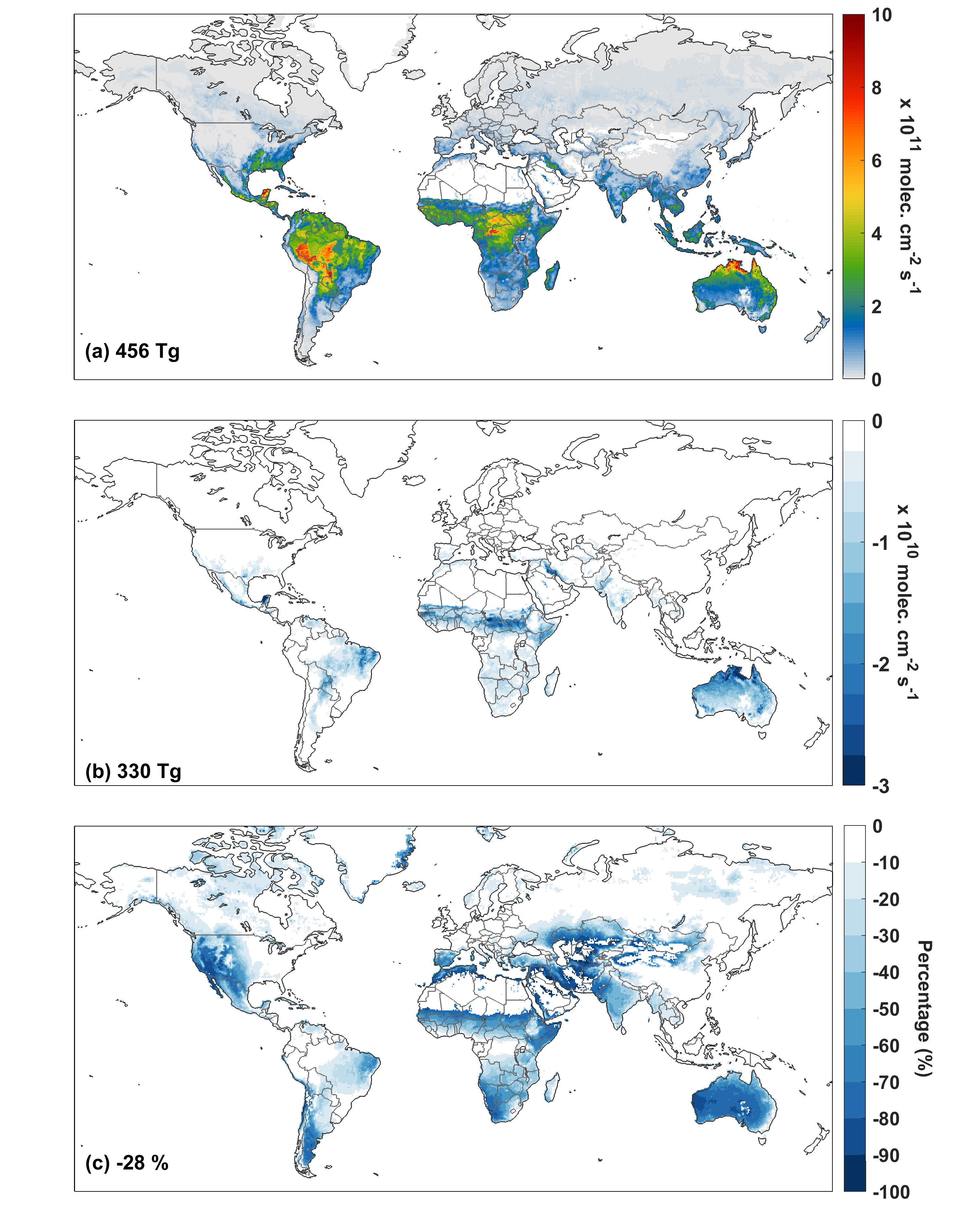
The figure shows global annual mean isoprene emissions averaged over 2005–2024, without drought effects (a), and the corresponding absolute (b) and relative (c) impacts of drought. Insets display the total global annual emissions (Tg of isoprene) with and without the effect of drought, along with the percentage reduction due to drought.
Download
Below, we provide annual NetCDF files containing the global daily emission inventory on a 0.5°×0.5° grid for the period 2005–2024. Each file includes 720 longitude points (179.75°W to 179.75°E), 360 latitude points (89.75°S to 89.75°N) and 365/366 daily index points (1-365/366).
A DOI has been assigned to this dataset: https://doi.org/10.18758/wsa1oabs.
The files contain two main daily variables:
- ‘isoprene_flux’: isoprene fluxes (in molec. cm-2 s-1), where the effect of drought stress is neglected.
- ‘drought_factor’: drought factor (ranging from 0 to 1) based on the offline Parameterized Drought Stress (PDS) substrate-supply parameterisation (γD = γSUB in Wang et al., 2022), representing a daily activity factor applied as a multiplicative correction to the isoprene fluxes above to account for drought stress.
About the CONCERTO bottom-up dataset
The CONCERTO bottom-up dataset is an emission inventory of isoprene emissions generated by the MEGANv2.1 model (Guenther et al., 2012) coupled with the multi-layer canopy environment model MOHYCAN (Müller et al., 2008) and driven by ECMWF ERA5 meteorological fields.
The drought activity factor γD is calculated based on the offline PDS parameterisation accounting for the substrate supply γSUB following Wang et al. (2022). Drought severity is quantified by the ratio fPET = AET/PET, defined as the ratio of actual evapotranspiration (AET) to potential evapotranspiration (PET), the latter calculated using the Penman-Monteith equation (Allen et al., 1998). Daily averaged values of fPET are derived from AET flux using ERA5-Land meteorological fields (Muñoz-Sabater et al., 2021), whereas PET is calculated from meteorological variables obtained from ERA5 (Hersbach et al., 2020). A 7-day running mean of fPET is subsequently normalised at each grid cell to the 0-1 range, where the value of 1 corresponds to the 95th percentile over the 2004-2024 period.
The resulting dataset CONCERTO is daily updated between 2005 and 2024 and is described in detail in Opacka et al. (in preparation). This study shows that changes in emissions and seasonality implied by the drought factor are largely supported by evaluations of a global chemistry-transport model against satellite isoprene observations from the Cross-track Infrared Sounder (CrIS) (Wells et Millet, 2022).
References
-
Allen, R. G., Pereira, L. S., Raes, D., and Smith, M.: Crop evapotranspiration-Guidelines for computing crop water requirements, Tech. Rep. 56, FAO, Rome, iSBN 92-5-104219-5, 1998.
-
Guenther, A. B., Jiang, X., Heald, C. L., Sakulyanontvittaya, T., Duhl, T., Emmons, L. K., and Wang, X.: The Model of Emissions of Gases and Aerosols from Nature version 2.1 (MEGAN2.1): an extended and updated framework for modeling biogenic emissions, Geosci. Model Dev., 5, 1471–1492, https://doi.org/10.5194/gmd-5-1471-2012, 2012.
-
Hersbach, H., Bell, B., Berrisford, P., Hirahara, S., Horányi, A., Muñoz-Sabater, J., Nicolas, J., Peubey, C., Radu, R., Schepers, D., Simmons, A., Soci, C., Abdalla, S., Abellan, X., Balsamo, G., Bechtold, P., Biavati, G., Bidlot, J., Bonavita, M., De Chiara, G., Dahlgren, P., Dee, D., Diamantakis, M., Dragani, R., Flemming, J., Forbes, R., Fuentes, M., Geer, A., Haimberger, L., Healy, S., Hogan, R. J., Hólm, E., Janisková, M., Keeley, S., Laloyaux, P., Lopez, P., Lupu, C., Radnoti, G., de Rosnay, P., Rozum, I., Vamborg, F., Villaume, S., and Thépaut, J.-N.: The ERA5 global reanalysis, Quarterly Journal of the Royal Meteorological Society, 146, 1999–2049, https://doi.org/10.1002/qj.3803, 2020.
-
Müller, J.-F., Stavrakou, T., Wallens, S., De Smedt, I., Van Roozendael, M., Potosnak, M. J., Rinne, J., Munger, B., Goldstein, A., and Guenther, A. B.: Global isoprene emissions estimated using MEGAN, ECMWF analyses and a detailed canopy environment model, Atmospheric Chemistry and Physics, 8, 1329–1341, https://doi.org/10.5194/acp-8-1329-2008, 2008.
-
Muñoz-Sabater, J., Dutra, E., Agustí-Panareda, A., Albergel, C., Arduini, G., Balsamo, G., Boussetta, S., Choulga, M., Harrigan, S., Hersbach, H., Martens, B., Miralles, D. G., Piles, M., Rodríguez-Fernández, N. J., Zsoter, E., Buontempo, C., and Thépaut, J.-N.: ERA5-Land: a state-of-the-art global reanalysis dataset for land applications, Earth System Science Data, 13, 4349–4383, https://doi.org/10.5194/essd-13-4349-2021, 2021.
- Opacka, B., Stavrakou, T., Müller, J.-F., Oomen, G.-M., Wang, H., Guenther, A.B., Wells, K.C., Millet, D., Seco, R. and Potosnak, M.: Drought-induced isoprene emission changes in MEGANv3.2 evaluated with field and satellite CrIS data, in preparation, 2026.
-
Wang, H., Lu, X., Seco, R., Stavrakou, T., Karl, T., Jiang, X., Gu, L., and Guenther, A. B.: Modeling Isoprene Emission Response to Drought and Heatwaves Within MEGAN Using Evapotranspiration Data and by Coupling With the Community Land Model, Journal of Advances in Modeling Earth Systems, 14, e2022MS003 174, https://doi.org/10.1029/2022MS003174, 2022.
-
Wells, K. C. and Millet, D. B.: ROCR Isoprene Retrievals from the CrIS Satellite Sensor., https://doi.org/10.13020/5n0j-wx73, 2022.


